INTERIOR DESIGN & DECORATION: GENERAL INFORMATION
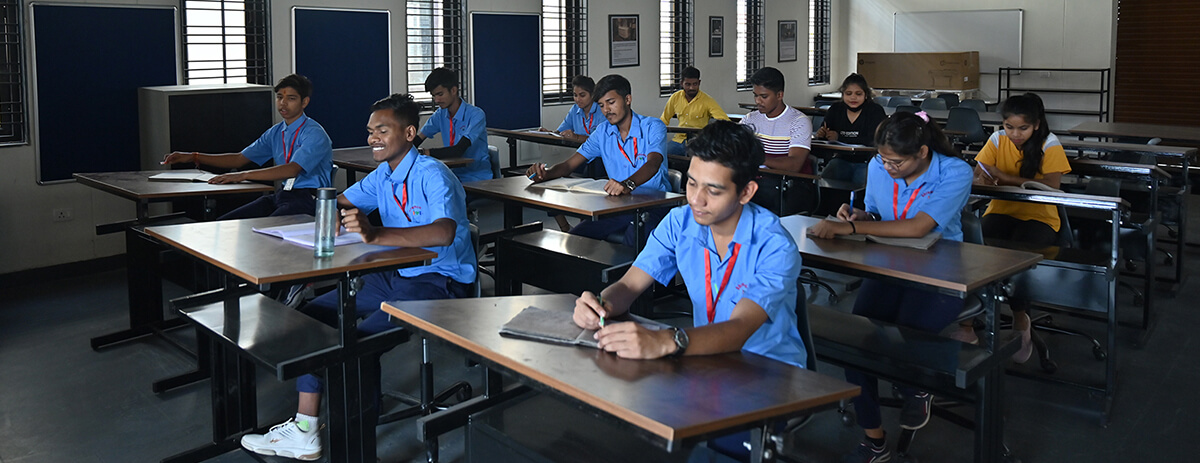
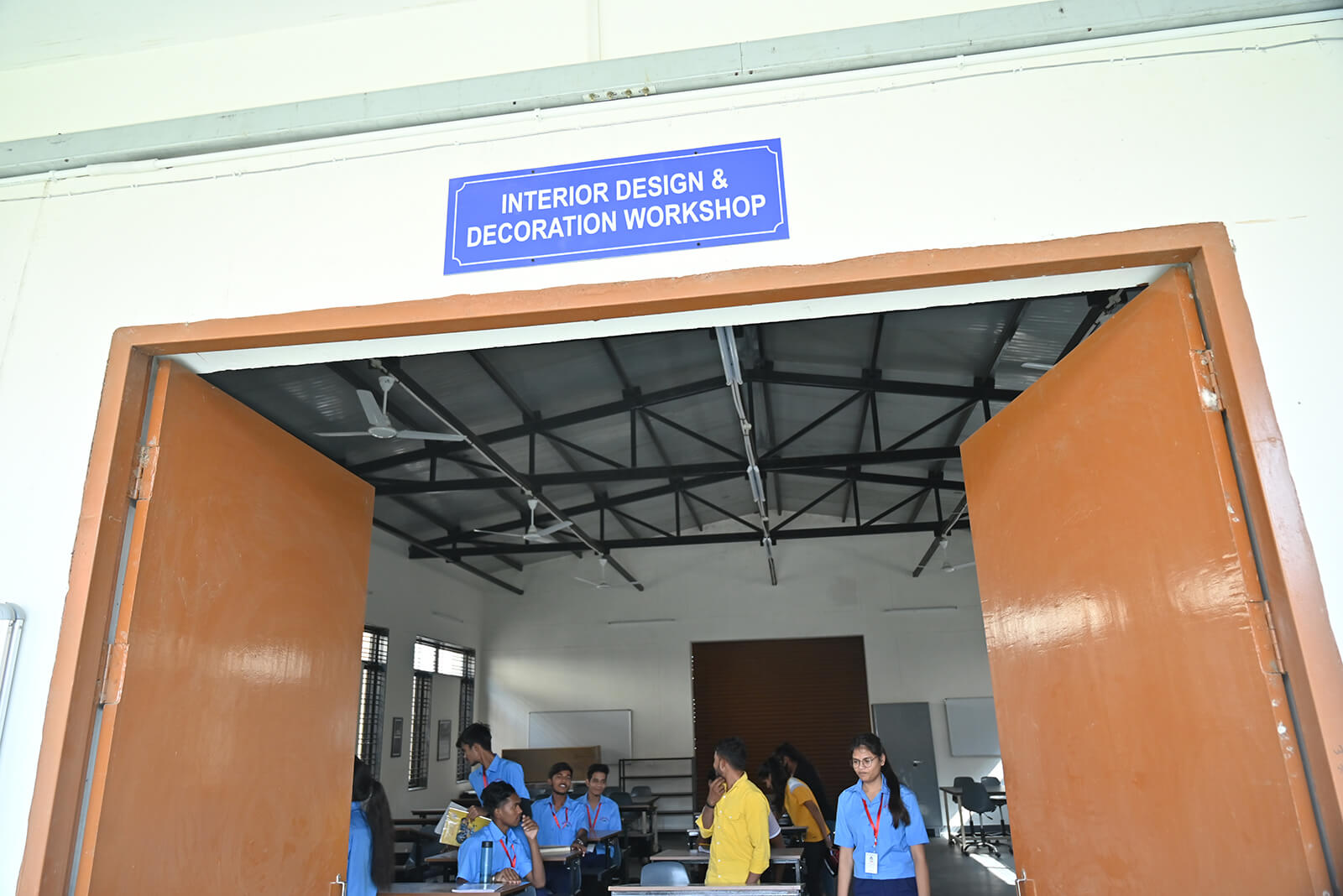
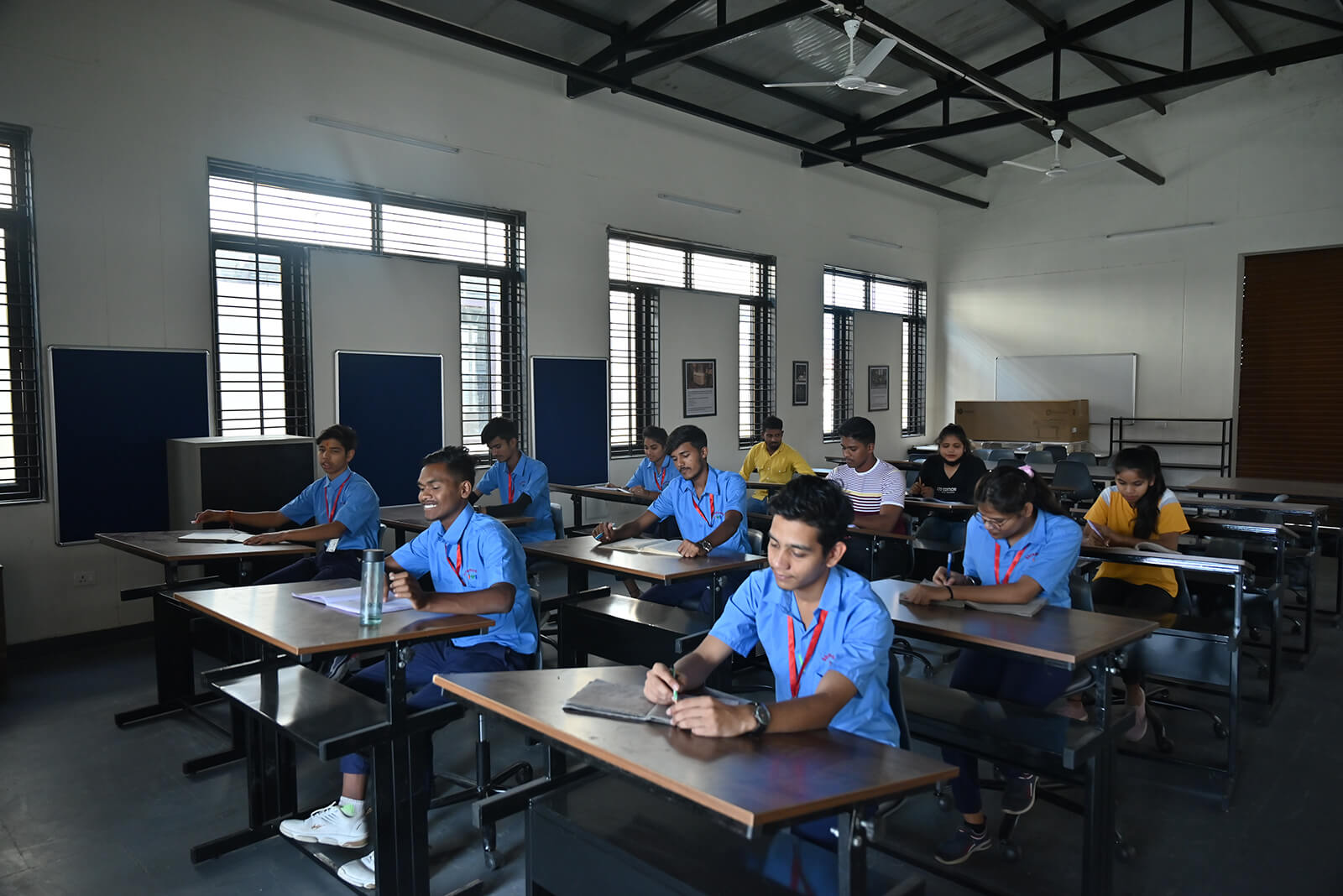
| Name of the Trade | INTERIOR DESIGN & DECORATION (Engineering Trade) |
|---|---|
| Trade Code | DGT/1037 |
| NCO - 2015 | 3432.0100, 3432.0200, 2163.0400 |
| NOS Covered | IES/N9454 IES/N9455 IES/N9456 IES/N9457 IES/N9458 IES/N9459 IES/N9460 IES/N9461 IES/N9462 IES/N9463 IES/N9464 IES/N9465 IES/N9466 IES/N9467 IES/N9468 IES/N9469 IES/N9470 IES/N9471 IES/N9472 IES/N9473 IES/N9402 |
| NSQF Level | Level – 3 |
| Duration of Craftsmen Training | One Year (1200 hours + 150 hours OJT/Group Project) |
| Entry Qualification | Passed 10th class examination with Science and Mathematics or with vocational subject in same sector or its equivalent. |
| Minimum Age | 14 years as on first day of academic session. |
During the one-year duration of “Interior Design & Decoration” trade a candidate is trained on professional skill, professional knowledge and Employability skill related to the job role. In this trade we don't just teach Interior Design, we encourage each and every student to access and nurture their own natural sense of flair and creativity. We also help them to know that how can they create new ideas, thoughts and also to execute them in real form. In addition to this a candidate is entrusted to undertake project work, extracurricular activities and on job training to build up confidence. The broad components covered under Professional Skill subject are as below:-
INTERIOR DESIGN & DECORATION: Year wise Trade Overview
During one year duration trainee learns about elementary first aid, fire fighting, environment regulation and housekeeping etc. The trainee gains knowledge for using drawing instrument and other supporting tools. The trainee draws various drawings of Interior design. The trainee learns to apply various tools and plan the design & position of furniture etc. with suitable layout. He/ she will be able to identify and classify various types of drawing, scale, analyze and prepare drawing according to place. The trainee learns to make small residential drawing plan with schedule sizes of furniture & apply color scheme. The trainee will be able to draw perspective view and prepare Power Point Presentation with various design process. The trainee can perform different designs on planning along with Auto Cad software.
The trainee learns 2D Software designs. He/she can make drawing of different sizes in correct scale on computer with the help of design software. The trainee can perform different operations on software along with different designs i.e. false ceiling, flooring, carpentry joints, partition wall, etc. The trainee will be able to draw various door & window frame and door - window designs. The trainee will be able to draw different types of layout designs for plumbing, lighting, Air Conditioning, etc. He/ she will be able to analyze & uses of paint, polish and varnish. The trainee will draw various type of small commercial planning with color scheme. The trainee will be able to check, identify, analyze, and draw the Interior jobs.
The trainee also undergoes two weeks project work at the mid and end of the year which gives them more practical exposure and helps to build up confidence level.
GENERAL
The Directorate General of Training (DGT) under Ministry of Skill Development & Entrepreneurship offers a range of vocational training courses catering to the need of different sectors of economy/ Labour market. The vocational training programmes are delivered under the aegis of Directorate General of Training (DGT). Craftsman Training Scheme (CTS) with variants and Apprenticeship Training Scheme (ATS) are two pioneer schemes of DGT for strengthening vocational training.
Interior Design & Decoration trade under CTS is one of the popular courses delivered nationwide through a network of ITIs. The course is of one-year duration. It mainly consists of Domain area and Core area. In the Domain area (Trade Theory & Practical) imparts professional skills and knowledge, while Core area (Employability Skill) imparts requisite core skills, knowledge, and life skills. After passing out the training programme, the trainee is awarded National Trade Certificate (NTC) by DGT which is recognized worldwide.
Trainee broadly needs to demonstrate that they are able to:
- Read & interpret technical parameters/documentation, plan and organize work processes, identify necessary materials and tools;
- Perform tasks with due consideration to safety rules, accident prevention regulations and environmental protection stipulations;
- Apply professional knowledge, core skills & employability skills while performing the job, and repair & maintenance work.
- Check the task/assembly as per drawing for functioning, identify and rectify errors in task/assembly.
- Document the technical parameters in tabulation sheet related to the task undertaken.
PROGRESSION PATHWAYS
- Can join industry as Technician and will progress further as Senior Technician, Supervisor and can rise up to the level of Manager.
- Can become Entrepreneur in the related field.
- Can join Apprenticeship programme in different types of industries leading to National Apprenticeship certificate (NAC).
- Can join Crafts Instructor Training Scheme (CITS) in the trade for becoming instructor in ITIs.
- Can join Advanced Diploma (Vocational) courses under DGT as applicable.
COURSE STRUCTURE
Table below depicts the distribution of training hours across various course elements during a period of one year:
| S No. | Course Element | Notional Training Hours |
|---|---|---|
| 1 | Professional Skill (Trade Practical) | 840 |
| 2 | Professional Knowledge (Trade Theory) | 240 |
| 5 | Employability Skills | 120 |
| Total | 1200 |
Every year 150 hours of mandatory OJT (On the Job Training) at nearby industry, wherever not available then group project is mandatory.
| On the Job Training (OJT)/ Group Project | 150 |
|---|
Trainees of one-year or two-year trade can also opt for optional courses of up to 240 hours in each year for 10th/ 12th class certificate along with ITI certification, or, add on short term courses.
LEARNING OUTCOMES
- Appraise the importance of interior designing & drawing instruments, drawing sheets, lettering following safety precautions. (Nos: IES/N9454)
- Draft the Geometrical shapes and projection with the help of engineering scale and free hand sketches. . (Nos: IES/N9455)
- Draft the design with the help of colour scheme and apply with rules and calculations. Analysis and uses of building materials. . (Nos: IES/N9456)
- Draw furniture designing & detailing. . (Nos: IES/N9457)
- Draw residential plan with necessary working drawing. . (Nos: IES/N9458)
- Draw different types of staircase. (Nos: IES/N9459)
- Apply basic knowledge of structural part of building. (Nos: IES/N9460)
- Draw doors and windows & details. (Nos: IES/N9461)
- Draw one- and two-point’s perspective view. (Nos: IES/N9462)
- Prepare the power point presentation with animation. (Nos: IES/N9463)
- Create object on 2D using tool bars, commands. (Nos: IES/N9464)
- Draw different types of false ceiling by using CAD. (Nos: IES/N9465)
- Draw different types of flooring by using CAD. (Nos: IES/N9466)
- Draw different types of carpentry joints by using CAD. (Nos: IES/N9467)
- Analyse and uses of paints, polish and varnish. (Nos: IES/N9468)
- Draw different types of partition wall by using CAD. (Nos: IES/N9469)
- Draw plumbing and drainage detail & sanitary fittings by using CAD. (Nos: IES/N9470)
- Draw lighting and electrical layout plan by using CAD. (Nos: IES/N9471)
- Draw air conditioning layout by using CAD./other using software. (Nos: IES/N9472)
- Draw commercial interiors by using CAD./other using software. (Nos: IES/N9473)
- Demonstrate basic mathematical concept and principles to perform practical operations. Understand and explain basic science in the field of study. (Nos: IES/N9402)